
Iran Tightens Measures in Hormuz as Washington Faces Military Pressure Over War
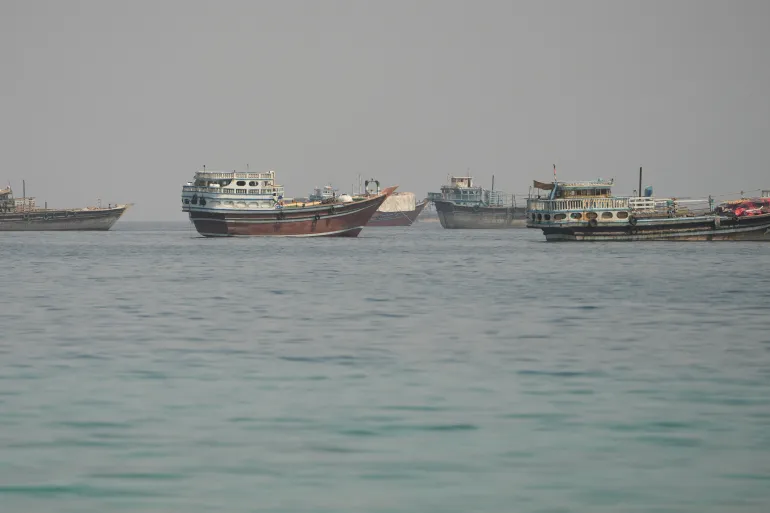
Al-Taj News – Iran’s Mehr News Agency reported Sunday, citing an Iranian source, that Iranian armed forces prevented 30 vessels from transiting the Strait of Hormuz over the past week, allegedly for violating the designated route and approved transit procedures, as it put it.
The source added that passage through the strait is currently restricted to the route designated by Iran, with coordination with Tehran and payment of the prescribed fees required, noting that the current situation is witnessing a “sharp halt” in navigation and trade movement through the strait.
Regarding U.S. statements about mine clearance operations in the Strait of Hormuz, the Iranian source said: “These claims cannot be confirmed… and Washington has not provided any documents proving that mine clearance operations were carried out.”
These developments come as Tehran continues to affirm that its forces remain engaged in carrying out their military missions. Tasnim News Agency quoted the commander of the Iranian Navy as saying that his country’s forces “will continue their mission with full force and will spare no effort in defending Iran, ensuring the security of the Iranian people and safeguarding it,” as he put it.
In a related development, NourNews reported that Iranian President Masoud Pezeshkian will travel to Kyrgyzstan to participate in the Shanghai Cooperation Organization summit, amid continued regional tensions linked to the war with the United States.
The Iranian president’s participation in the summit carries political significance as Tehran seeks to strengthen its relations with the organization’s member states, alongside the ongoing military confrontation and international pressure on it.
Meanwhile, The Washington Post, citing informed sources and military officials, revealed growing pressure within the U.S. military establishment due to the continuation of operations against Iran and the prolonged military deployment in the Middle East.
The newspaper said that the U.S. Army’s 82nd Airborne Division will remain in the Middle East until at least next September, noting that military officials expect the unit’s deployment to be extended for a longer period, given that it would be central to any potential ground invasion of Iran.
The newspaper quoted informed sources as saying that the U.S. Chief of Naval Operations told Secretary of War Pete Hegseth that the Navy could not maintain its current level of support for the conflict with Iran, given the lack of an expected date for the end of operations.
According to the same sources, the Chief of Naval Operations told Hegseth that only about one-quarter of the U.S. Navy’s destroyer fleet was now ready for deployment, representing a sharp decline compared with readiness levels before the war.
The Washington Post reported that some generals and admirals had been more candid than usual in telling Hegseth that they opposed orders to continue providing equipment and personnel for operations against Iran, amid uncertainty over the course of the war and how long it might last.
The newspaper also quoted informed sources as saying that withdrawing ships, aircraft and other equipment from U.S. combatant commands responsible for operations in Europe, Asia and Latin America to support the war in Iran had limited those commands’ ability to carry out their missions and maintain the required levels of training.
The sources indicated that the U.S. Navy, in particular, had been forced to make additional efforts to meet the demands of the war, while the Army and Air Force leadership agreed with Hegseth’s desire to extend troop deployment periods, while emphasizing that this entailed significant risks.
The Washington Post said that the Secretary of Defense’s order guide issued on August 14 directs some forces deployed in the Middle East to remain there until September 2026, while other forces are required to continue their deployment until 2027.
According to the newspaper’s sources, the possibility of extending the presence of U.S. forces prompted a number of military commanders to express concerns.